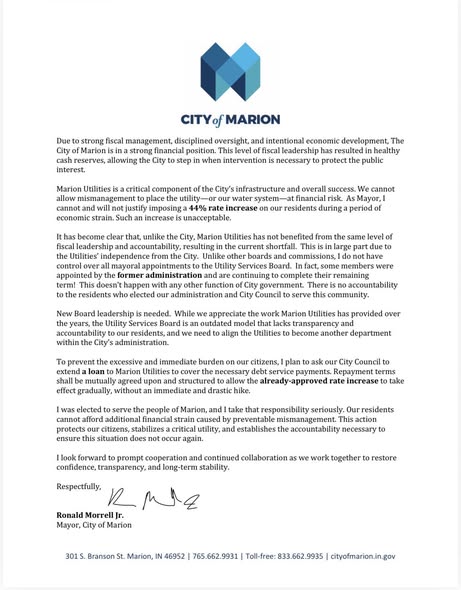
This response addresses the mayor’s public statement following his decision to veto the water rate increase. The claims below are drawn from that written statement and evaluated against the historical record, meeting discussion, and the governance structure originally adopted by Marion voters.
Claim: The Utility’s Financial Distress Is Due to Mismanagement
This claim is false and misleading.
The reason for the utility’s financial distress is rooted in an 18-year period from 2005 to 2023 where rates were not increased despite rising costs (Timestamp 19:57–20:03, Jan. 20). Beginning around 2016, the utility was spending down its reserves (Timestamp 10:38–10:49, Jan. 20). Shortly after, around 2016–2017, another rate increase was attempted and denied (Timestamp 35:57, Jan. 20).
To attribute the current position to “mismanagement” ignores the documented sequence that made financial deterioration increasingly likely. Management implies discretionary failure. What occurred here was politically imposed underfunding.
Claim: A 44% Rate Increase Is Unjustifiable
This claim is technically true, but materially misleading.
The mayor cites a “44%” increase without clarifying two facts: it applies only to the water portion of the bill (Timestamp 34:21–34:48, Jan. 20), and the practical monthly impact was described as roughly $4 to $8 per month (Timestamp 52:01, Jan. 20).
Omitting that context encourages public reaction to a headline percentage rather than the actual consumer effect. Transparency requires stating real-world impact, not percentage alone.
Claim: Utility Independence Is a Bad Thing
This claim collapses under historical precedent and context.
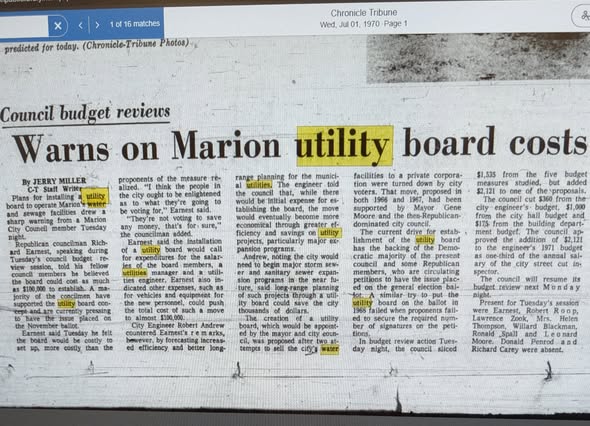
The utility’s independence was not accidental. In 1966 and 1967, efforts were made to sell the utility to a private for-profit corporation under Mayor Gene Moore, with support from the City Council. Those efforts were rejected, and a board to regulate the utility was later proposed (Marion Chronicle-Tribune, July 1, 1970).
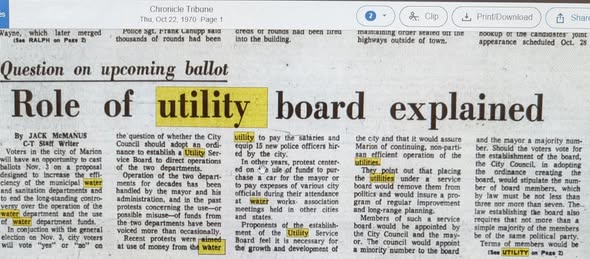
At the time, funds were being appropriated from the utility to other city departments rather than remaining within the utility for service and system growth (Marion Chronicle-Tribune, Oct. 22, 1970). There was also controversy surrounding the use of utility funds for a car for the mayor and travel expenses for officials tied to utility-related meetings (Marion Chronicle-Tribune, Oct. 22, 1970).
According to the Marion Chronicle-Tribune on Oct. 22, 1970, the goals behind the utility board were to:
- Increase the efficiency of both the water and sanitation departments.
- End the long-standing controversy surrounding the use of funds and utility operations.
- Assure Marion of non-partisan and efficient operation.
- Remove the utility from short-term politics and ensure regular improvement and long-range planning.
This structure was intended to prevent asset stripping, stop politically motivated underinvestment, remove water operations from short-term political incentives, and align governance with decades-long horizons rather than four-year electoral ones.
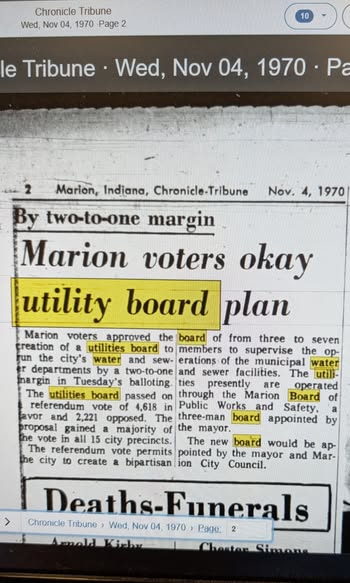
Marion voters, by popular vote, established the board on Nov. 4, 1970. City politics operate on electoral timelines. Water systems do not. Independence was, and remains, a structural safeguard.
Claim: The Utility Board Is Not Accountable to the Public
This claim is false.
The utility is subject to public disclosure of budgets and expenditures (Timestamp 9:33–9:45, Jan. 20) and to regulatory oversight and reporting requirements (Timestamp 1:49–4:13, Jan. 20).
The board model was also meant to increase accountability relative to the earlier system, which concentrated more direct control in the hands of the mayor and other officials (Marion Chronicle-Tribune, Oct. 22, 1970). Less political control does not mean less public accountability. In many cases, it means more.
Claim: Utilities Should Be Folded Into City Administration
This proposal directly reverses the safeguards adopted by voters more than 50 years ago.
Before the utility board was created, funds designated for water infrastructure were diverted to other city departments, weakening the system and delaying maintenance. The independent structure helped ensure that utility revenues stayed within the utility and that infrastructure funding was insulated from political reprioritization (Marion Chronicle-Tribune, Oct. 22, 1970).
Even if a current administration exercises restraint, that assumption cannot be the basis of infrastructure governance. Critical infrastructure must be built for worst-case incentives, not best-case personalities.
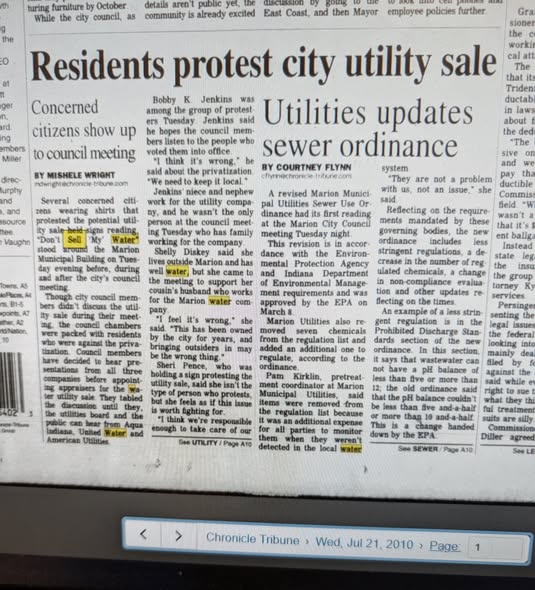
The historical record also shows repeated attempts by city leadership to sell the utility to a for-profit private corporation (Marion Chronicle-Tribune, July 21, 2010). Re-centralization makes future privatization easier, not harder, and privatization would replace public ownership and public control with shareholder incentives.
Claim: A Loan Extension Is Needed to Stabilize the Utility
This claim is unnecessary and misdirected.
The utility is already being temporarily supported by an approximately $1.8 million inter-departmental loan from the wastewater utility (Timestamp 21:13–21:32, Jan. 20). That is a band-aid, not a cure (Timestamp 4:25–4:45, Jan. 20).
If the approved rate increases proceed:
- The utility operates in the green (Timestamp 4:07–4:19, Jan. 20).
- The loan from wastewater can be repaid (Timestamp 34:10–34:53, Jan. 20).
- Long-term compliance and capital planning begin to stabilize.
Loans treat symptoms. Rates fix the disease.
References
- City of Marion Public Works Committee — January 20, 2026: YouTube recording
- Marion voters okay utility board plan. Marion Chronicle-Tribune. Nov. 4, 1970.
- Morrell, R. (Mayor). Written statement on Marion Utilities governance and rate increases.
- Residents protect city utility sale. Marion Chronicle-Tribune. July 21, 2010.
- Role of utility board explained. Marion Chronicle-Tribune. Oct. 22, 1970.
- Warns on Marion utility board costs. Marion Chronicle-Tribune. July 1, 1970.
Supporting Images